Have you ever thought of what you do every day to have the best quality of life possible? of do you just get up run around all day and go to bed only to start over agin tomorrow.
As we will all slowly find out, we are not the indestructible 20 year old for long. As our demands change with the years, the job, family, the week seems to get shorter and shorter with less and less time for us to do the things we used to do to keep the negative stresses at bay, and we need to now more than ever find and make the time and priority to invest in ourselves so that we can go through our 40ies, 50ies, 60ies feeling as good as we did in our 20ies.
Now is the time to act. Not tomorrow. Not next week. The years are going by to quickly to put it off! Do something about that niggle, that headache, that back ache, that neck ache, the slow decrease of energy. Invest some time in yourself and it will reap rewards you thought you had lost and would not get back.
Showing posts with label back pain. Show all posts
Showing posts with label back pain. Show all posts
Friday, 4 November 2011

Monday, 8 August 2011
The Spinal Model
The Spinal Model
Complete Chiropractic St Albans, First Floor, 15 High Street, St Albans Herts AL3 4EH Ph. 01727 848 481
Your body and spine is an incredible marvel of engineering, being able to withstand large forces and yet maintaining great flexibility.
The ideal spine at rest consumes practically no energy to support upright standing posture. If it were to be maintained properly, the spine could easily last 120-150 years with minimal degeneration or arthritis.
 The Harrison Spinal Model http://www.idealspine.com/ is our goal of care for correction. Just like blood pressure, there are normal ranges for spinal alignment. When you fall outside of these normal ranges, the spine will degenerate faster than it should and wear like a car tire that is not properly balanced.
 The human spine should be straight from the front and have 3 curves when viewed from the side
It is quite obvious why our spines need to be as straight as possible from the front, but those without an engineering background may fail to see the need for curves when viewed from the side.
Let's take the neck for example.

The arc in the neck provides leverage for muscles which move the head, while also distributing the forces of gravity through the spine.
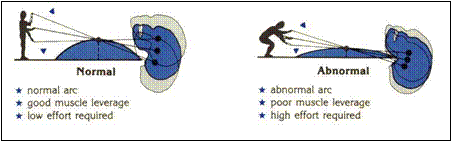
 The ideal shape of the spine is an amazing balance of natural
 forces that are constantly challenging us. These include such loads as compression, tension and shear. How efficient our spines are to resisting these detrimental forces is di
rectly related to health.
By altering and restoring the natural curves of the spine we can help you get rid of neck and low back pain and prevent the spine from wear and tear.
Wednesday, 20 July 2011
Good Posture How Important Is It?
Posture is as important as eating right, exercising and getting a good night's sleep.
Good posture helps contribute to the normal functioning of the nervous system.
The good news is that most everyone can avoid the problems caused by bad posture...and you can make improvements at any age.
Without good posture, your overall health and total efficiency may be compromised. The long-term effects of poor posture can affect bodily systems such as digestion, elimination, breathing, muscles, joints and ligaments.
Even for younger people, how you carry yourself when working, relaxing or playing can have big effects. Did you know that just fifteen minutes reading or typing when using the wrong positions exhausts the muscles of your neck, shoulders and upper back and can lead to neck and back pain?
Often, poor posture develops because of accidents or falls. But bad posture can also develop from environmental factors or bad habits.
Today, posture-related problems are increasing as we are becoming a society that watches more TV than any previous generation, more people working at desk jobs or sitting in front of a computer, more cars are crowding our roads, resulting in accidents and injuries and we drive in cars with poorly designed seats.
In most cases, poor posture results from a combination of several factors, which can include:
1. Accidents, injuries and falls
2. Poor sleep support (mattress)
3. Excessive weight
4. Visual or emotional difficulties
5. Foot problems or improper shoes
6. Weak muscles, muscle imbalance
7. Careless sitting, standing, sleeping habits
8. Negative self image
9. Occupational stress
10. Poorly designed work space
What are you going to do about it?
Subscribe to:
Posts (Atom)